
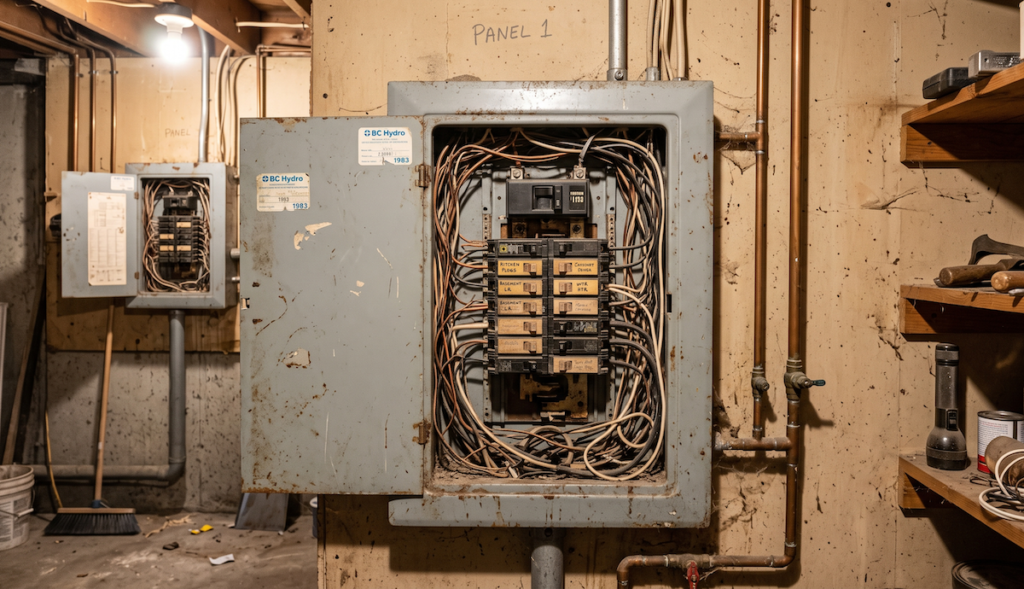
Most homeowners don’t give their electrical panel a second thought. It sits behind a door in the laundry room or garage, and as long as the lights come on, it’s easy to assume everything is fine.
But if your home was built before the 1990s or if you’ve never had your panel inspected, there’s a real chance you’re living with equipment that was recalled, flagged as a fire hazard, or quietly deemed uninsurable by your insurance company.
This isn’t meant to alarm you. It’s meant to give you the facts, because in the Okanagan, we see these panels regularly. And the homeowners who catch them early avoid the ones who find out the hard way.
The Panel Brands That Raise Red Flags
Not every old panel is dangerous, but certain brands have a well-documented history of failure. Here are the ones that consistently come up in insurance claims, inspections, and electrician reports across Canada:
Federal Pacific Electric (FPE) / Stab-Lok
This is the most talked-about problem panel in North America. FPE Stab-Lok breakers were widely installed in Canadian and American homes from the 1950s through the 1980s. The core issue: the breakers frequently fail to trip during an overload or short circuit. That means when your wiring overheats, the breaker designed to stop the problem doesn’t.
Independent testing and fire investigations have linked these panels to thousands of house fires. They are no longer manufactured, and many Canadian insurers will not provide coverage if one is present in your home.
Zinsco (and GTE-Sylvania Zinsco)
Zinsco panels were popular through the 1970s and share a similar failure mode to Stab-Lok. The breakers can fuse to the bus bar over time, meaning they physically cannot trip. The aluminum bus bars are also prone to melting under sustained heat. If you have a Zinsco, it warrants immediate attention.
Pushmatic (Bulldog) Panels
Pushmatic panels use a push-button breaker design and contain no main shutoff breaker; you have to trip every breaker individually to cut power. Beyond the inconvenience, the breakers harden with age and can fail to trip properly. They’re also incompatible with modern AFCI and GFCI breaker technology, which limits your ability to meet current code.
Older Split-Bus Panels
Split-bus panels common from the 1950s to mid-1960s divide the panel into two sections with no single main breaker. They’re not inherently dangerous in the same way, but they are outdated, often undersized for modern loads, and a nuisance during an emergency when you need to shut power off quickly.
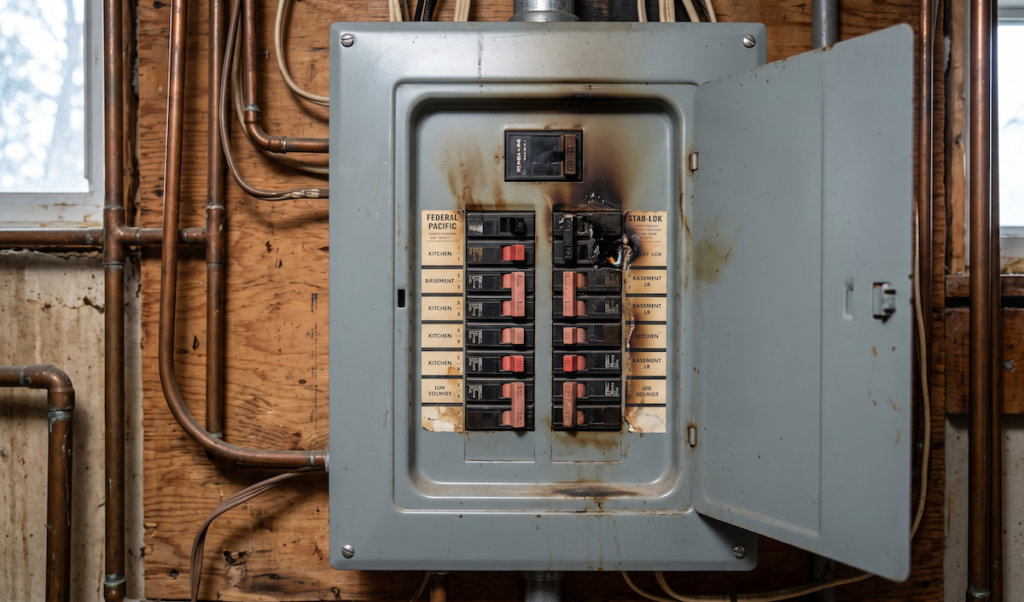
The Insurance Problem Is Real (and Getting Worse)
This is the part that catches a lot of homeowners off guard. You might be aware your panel is old. You might have been planning to address it. But the urgency tends to shift when people find out their insurance coverage is at stake.
Here’s what’s happening across BC and the rest of Canada:
- Many major insurers now ask directly about your panel brand on new applications and renewals.
- Homes with FPE Stab-Lok, Zinsco, or Pushmatic panels are being denied coverage outright or quoted significantly higher premiums.
- Some existing policies are being cancelled at renewal once an insurer becomes aware of the panel brand.
- If your panel is flagged and you have a fire, your claim may be denied or reduced depending on your policy language.
If you’re selling your home, this is also now a standard disclosure issue. A buyer’s inspection will flag these panels. Their insurer will flag them. And the sale can stall or fall through if the panel isn’t dealt with before closing.
Getting ahead of it is significantly less painful than reacting to it. A panel replacement done on your timeline, with proper permits and inspection, is straightforward. A panel replacement forced by a deadline or worse, by a loss, is not.
When the Brand Isn’t the Problem (But the Panel Still Is)
Not every panel upgrade is about a recalled brand. There are plenty of perfectly reputable panels Square D, Siemens, Cutler-Hammer that weren’t designed for the electrical demand a modern home puts on them.
A few things that push a panel toward replacement regardless of brand:
- Capacity: A 60-amp or 100-amp panel may have been fine in 1975. Add an EV charger, a heat pump, a hot tub, and modern appliances, and you’re pushing a system beyond what it was built to handle.
- Double-tapping: Two wires connected to a single breaker terminal is a code violation and a sign the panel has been worked around rather than upgraded.
- Physical condition: Corrosion, moisture intrusion, burn marks, or a persistent burning smell are never acceptable in an electrical panel.
- Repeated tripping: Breakers that trip regularly under normal load are telling you the panel is undersized or the breakers themselves are failing.
- Aluminum wiring: Homes from the late 1960s through 1970s often have aluminum branch circuit wiring. Combined with an older panel, this requires careful evaluation and usually remediation.
What a Panel Replacement Actually Involves
A panel upgrade isn’t just swapping one box for another. Done properly, it involves a licensed electrician pulling the correct permits, doing the work to current BC Electrical Code standards, and having it inspected before the panel is energized and closed up.
Here’s a realistic picture of the process:
- The utility (FortisBC for most of the Okanagan) is coordinated to disconnect power at the meter.
- The old panel is removed, and the new panel is installed and connected.
- All circuits are properly labelled and verified.
- A permit is pulled, and a BC Safety Authority (BCSA) inspection is scheduled.
- Once the inspector approves, FortisBC reconnects power.
The whole process is typically done in a day for a straightforward residential upgrade. Most homeowners are without power for a half-day window while the work is completed.
When Kyle does a panel upgrade at Kemp Co Electric, the permit and inspection are handled as part of the job. You don’t coordinate with the utility yourself or schedule the inspection separately. That’s part of what makes the process stress-free.
How to Find Out What You Have
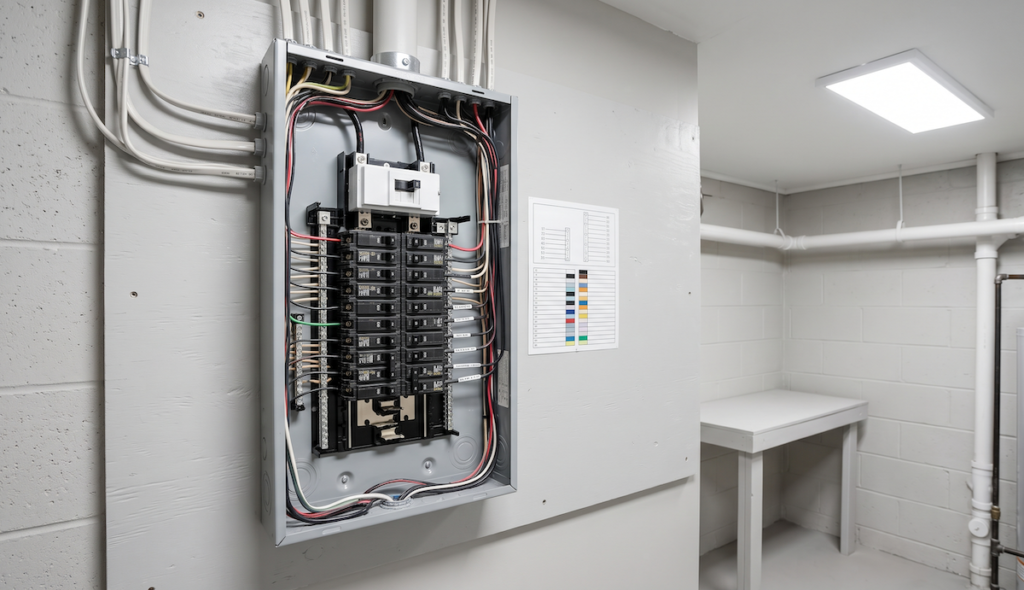
Open your panel door and look at the breakers. On older panels, the manufacturer name is typically printed or embossed on the breakers themselves or on the panel interior. If you see any of the following, it warrants a conversation with a licensed electrician:
- Federal Pacific Electric
- Stab-Lok (name or logo)
- Zinsco or GTE-Sylvania
- Pushmatic or Bulldog
If you’re not sure what you’re looking at, that’s fine too. A site visit is the fastest way to get a straight answer. Kyle will look at the panel, tell you exactly what you have, and give you a clear picture of whether replacement is urgent, something to plan for, or not necessary at all.
There’s no pressure and no upsell. If your panel is fine, he’ll tell you.
The Bottom Line
Electrical panels are one of those things where the cost of dealing with a problem proactively is a fraction of the cost of dealing with it after something goes wrong. A panel upgrade is a defined job with a defined cost and a clear outcome. A house fire or a denied insurance claim is not.
If your home is more than 25 years old and you’ve never had your panel looked at, that’s worth changing. Not because something is definitely wrong, but because knowing either way is worthwhile.
Ready to get a straight answer about your panel?
Kemp Co Electric serves Kelowna, West Kelowna, Peachland, Lake Country, and the surrounding Okanagan Valley. When you reach out, you’re talking directly to Kyle — the person who will actually do the work.
Get in touch for a site visit and a no-surprise quote. Permits and inspections are included. No middlemen, no guessing.
